

TL;DR
Most small businesses grow on word of mouth but have no system for it — they hope customers recommend them rather than making it happen. One garage owner started asking a single question at the till and traced 55% of new customers back to it over six months. The fix: one natural question at the right moment, plus an automated follow-up for feedback and reviews.
Fifty-five per cent. That is the share of new customers one garage owner traced back to a single question he started asking at the till.
Not a referral programme. Not a discount code. Not a landing page. One question, asked at the right moment, that did more for his pipeline than anything else he had tried in fifteen years of running the business.
I am going to tell you exactly what the question was, when he asks it, and why it works. But first I want to talk about the thing that stops most small business owners from ever getting here.
The feast-and-famine problem
When I sit down with a business owner and ask how they get their customers, the most common answer by a mile is “word of mouth.”
Great. So I ask what their referral process is.
And they look at me like I have asked them to explain gravity.
“People just recommend us. We do a good job and they tell their friends.”
That is not a system. That is hope. And hope is why so many small businesses live on a feast-and-famine cycle — busy one month, quiet the next, with no idea what changed.
The difference between passive word of mouth and active referral generation comes down to one thing: control. When you are actively generating referrals, you have a measure of control over how busy you are. When you are waiting for customers to remember you do what you do, you are leaving your business to chance.
The one question that changed a garage
A garage owner I work with — independent, been trading years, solid reputation locally — started doing something simple.
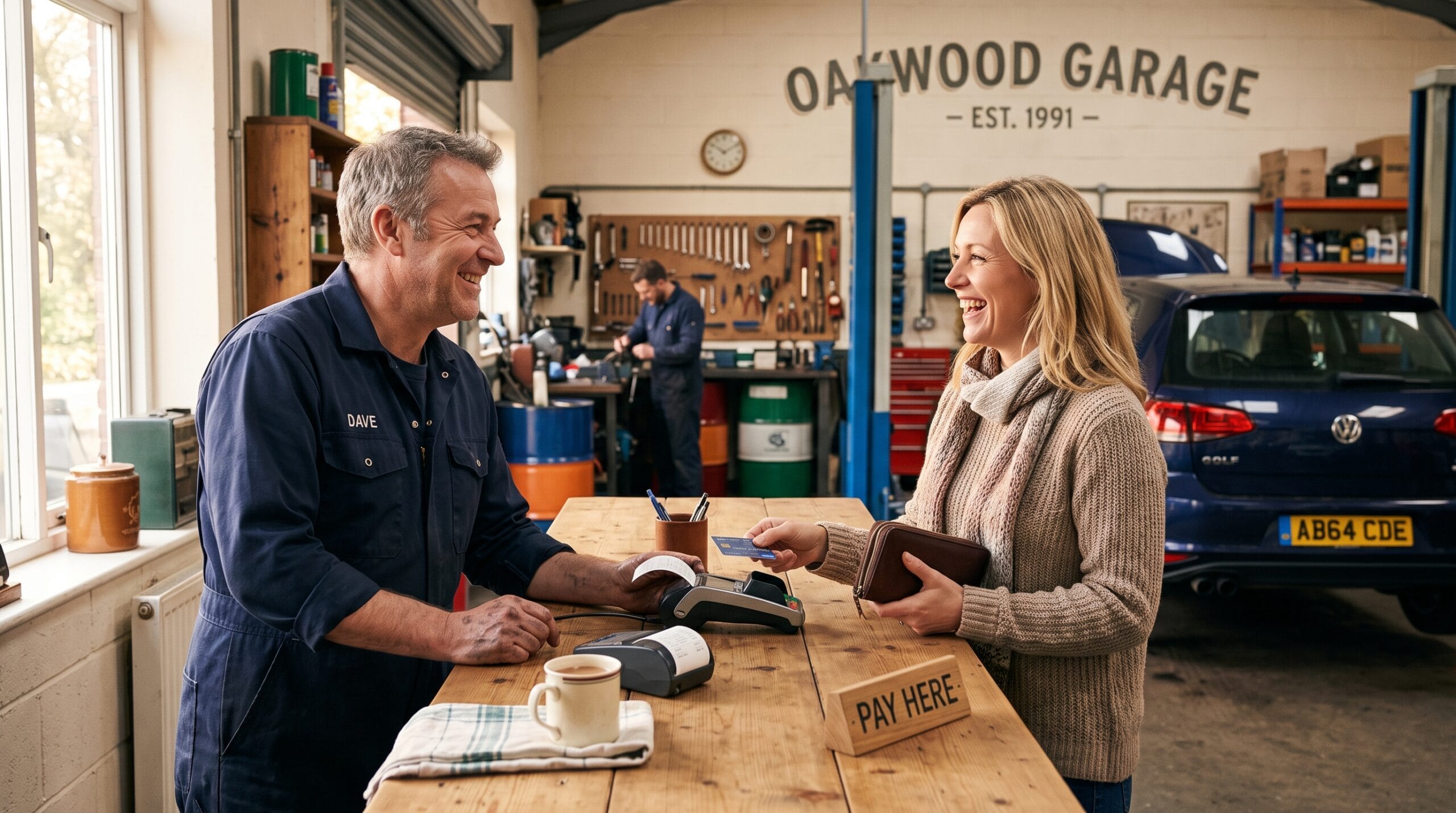
At the point where the customer is happy with the work — the MOT has passed, the service is done, the repair has been explained — and they are about to pay the invoice, he asks one question:
“How many vehicles are registered at your home address?”
That is it. No referral card. No incentive scheme. No awkward “do you know anyone who might need a mechanic?”
The customer is immediately thinking about who else at home needs a garage. A spouse. An adult child. A second car. A lodger. The question plants the seed without ever directly asking for a referral.
Over six months, 50 to 55 per cent of his new customers came to him through this route.
How did he know? Because he also asks every single customer how they heard about him. Which brings me to the diagnostic.
How to tell if you have a system or just a reputation
When an owner tells me they get most of their work from referrals, I run three checks:
Check 1: Do you actually know where your customers come from?
Ask your next 10 customers how they heard about you. Write it down. If you cannot tell me the answer with confidence, you are guessing — and guessing means you cannot deliberately do more of what is working.
Check 2: Are you collecting feedback?
How many of your customers are asked to give you honest feedback after the job? And what does that feedback look like — good, bad, or non-existent? If you are not asking, you do not know what your customers actually think. You only know what the ones who bother to complain think.
Check 3: Does that feedback go anywhere public?
How many of those happy customers go on to leave an online review? If the answer is “barely any,” you have proof sitting in text messages and conversations that never makes it to Google. That is a leak.
If you pass all three checks, you have something resembling a system. If you fail any of them, you are relying on chance. Most owners fail all three.
The simplest referral mechanism you can set up this week
You do not need software, a budget, or a referral programme for this. You need two things:
1. A question that fits naturally into the conversation.
The garage owner’s “how many vehicles” question works because it is relevant to the service he has just delivered. Find the version that fits your trade.
A gas engineer might ask: “Do any of your friends or family have a gas boiler? I offer a 10 per cent discount for friends and family.” It costs nothing. It does not feel like a sales pitch. It plants a seed in the customer’s mind at the exact moment they are happiest with your work.
An accountant might say at the end of a year-end meeting: “If you know any other business owners who might need help with their accounts, we would love an introduction.” One sentence. Takes three seconds.
2. An automated follow-up that does the bit you will forget.
After the job, send the customer a text or email asking for honest feedback and including a direct link to your Google Business Profile. Automate it so it goes out without you having to remember, because you will not remember. You will be driving to the next job, running late, thinking about the quote you need to send tonight.
That is the whole system. A question at the right moment. An automated nudge afterwards. One generates the referral. The other turns the happy customer into public proof.
What stops most owners from asking
It is rarely awkwardness. Most of the time it is simply not thinking about it.
A gas engineer might have four or five calls in a day. He starts early, finishes late, and spends half his time in transit. Asking a question at the end of every job sounds easy until you are running 20 minutes behind and the next customer is already texting to ask where you are.
That is exactly why the automation matters. The question is yours to ask in the moment — nobody can automate a genuine human conversation. But the follow-up text, the feedback request, the review link? That is precisely the kind of thing that only works when it happens every time, and no human does anything every time when they are busy.
Automate the part you will forget. Keep the part that only you can do.
Your next customer is probably already in your last customer’s phone
Most small business owners I meet have brilliant reputations and almost no system for turning that reputation into new work. The happy customers are there. The goodwill is there. The willingness to recommend is there.
What is missing is the ask and the follow-through.
One question at the right moment. One automated message afterwards. That is the gap between feast-and-famine and a steady pipeline.
Related reading:
- Why You’re Getting Enquiries But Not Customers
- How Fast Should You Respond to Leads?
- How Many Times Should You Follow Up With a Lead Before Giving Up?
- What Should I Do When Business Goes Quiet?
Key Takeaway
Your next customer is probably already in your last customer’s phone. Most owners have the reputation but not the system. One question at the right moment plus one automated follow-up is the gap between feast-and-famine and a steady pipeline.
Find out where your business is leaving referrals on the table.
Find our articles useful? Help us show up more in your Google results: